Haz clic aquí para ver el Calendario en Español.

(119 Ministries)
Biblical Appointed Times — 2026
Learn more about it
Jerusalem remains the reference location used to establish the biblical calendar. If you choose “Use My Location,” your browser will request location permission and use your coordinates only on this device to calculate the actual local sunset for each listed date. The plugin does not store your coordinates or send them to the WordPress database. Local observance times are an adjustment for your location and do not change the Jerusalem-based calendar dates. Because the biblical day begins at sundown, visitors should follow the local sunset shown for where they are physically located.
Shemini Atzeret (Eighth-Day Assembly)
Counts down to the feast beginning at sundown in Jerusalem.
Use My Location to activate this countdown using your local sundown.
Rosh Chodesh — Biblical Month 7
Jerusalem reference · Month began at sundown: Fri, Sep 11 · 6:50 PM IDT
Why the Biblical Appointed Times Matter
Leviticus 23 presents the weekly Shabbat and the annual appointed times as YHVH’s appointed times and repeatedly uses language such as “throughout your generations” and “statute forever.” This calendar presents them from a -observant, Yeshua-centered perspective.
Spring appointed times: the Apostolic Writings explicitly connect Yeshua with Pesach (Passover) (1 Corinthians 5:7) and Firstfruits/resurrection (1 Corinthians 15:20), while Acts 2 records the giving of the Holy Spirit at Shavuot (Feast of Weeks/Pentecost). Hag Matzot (Feast of Unleavened Bread) also carries the biblical picture of removing leaven and walking in sincerity and truth (1 Corinthians 5:8).
Autumn appointed times: many believers understand these as prophetic pictures pointing toward events associated with Yeshua’s return. This is an interpretive framework rather than an explicit one-to-one timetable stated in Leviticus 23. Common connections include the trumpet at the Lord’s descent (1 Thessalonians 4:16), repentance and mourning for the pierced one (Zechariah 12:10), and the future observance of Sukkot (Feast of Tabernacles) by the nations (Zechariah 14:16). Colossians 2:16–17 also describes festivals, new moons, and Sabbaths as a shadow of things to come, with the substance belonging to Messiah.
How This Biblical Calendar Is Calculated
The method used by this calendar
Scripture establishes the first month of the biblical year and identifies it with Aviv (Exodus 12:2; Exodus 13:4; Deuteronomy 16:1). It also places the spring appointed times and the Firstfruits harvest offering in this season (Leviticus 23:5–16). Scripture does not state a modern lunar illumination percentage and does not explicitly command either an annual barley inspection or the spring equinox as the test for declaring Month 1.
This calendar uses the astronomical new moon/conjunction in Jerusalem, approximately 0% illumination, as the lunar marker. For Month 1 it uses the conjunction nearest the spring equinox as an objective and reproducible seasonal anchor. The purpose of the seasonal anchor is to keep Month 1 (Aviv), Pesach (Passover), Hag Matzot (Feast of Unleavened Bread), and Yom HaBikurim (Feast of Firstfruits) aligned with the spring harvest season in which the commanded Firstfruits offering can occur. The equinox itself is therefore a calculation method used by this calendar; it is not presented as a Torah command.
Another observational approach
Other believers use an observational method that waits for the first visible lunar crescent and may examine Aviv-stage barley in Israel as a practical seasonal indicator before declaring Month 1. The reasoning is likewise connected to keeping the biblical month of Aviv and the spring feast cycle aligned with an actual spring harvest. This observational/Aviv approach should be distinguished from the later fixed rabbinic calendar; they are not necessarily the same method.
A note about different calendar interpretations: sincere believers who desire to observe YHVH’s appointed times use different methods. We respect those understandings and do not present this calendar for the purpose of debating them. This calendar simply documents and consistently applies the method we believe most closely aligns with the biblical references and their seasonal context.
Day boundary: Leviticus 23:32 explicitly gives an evening-to-evening boundary for the Day of Atonement. This calendar uses the same sundown-to-sundown convention when presenting biblical days. For each lunar reference, if conjunction occurs during the Jerusalem night, that night begins Day 1; if conjunction occurs during daylight, Day 1 begins at the following sundown.
Yom HaBikurim (Feast of Firstfruits) and Shavuot (Feast of Weeks): Leviticus 23:11, 15–16 places the wave sheaf on the day after the Sabbath and then commands a count of seven complete Sabbaths / fifty days. This calendar uses the weekly Sabbath occurring during Unleavened Bread, placing Yom HaBikurim (Feast of Firstfruits) on the first day of the week after that Sabbath and Shavuot (Feast of Weeks) on the fiftieth day. This is identified as an interpretive choice because other readings exist.
Weekly Shabbat
Shabbat is the seventh day. Genesis 2:2–3 establishes the seventh-day pattern; Exodus 20:8–11 commands Israel to remember and sanctify the seventh day; Exodus 31:16–17 calls Shabbat a perpetual covenant and sign throughout Israel’s generations. Leviticus 23:3 lists the weekly Shabbat before the annual appointed times and prohibits work.
When: this calendar follows the biblical evening-to-evening pattern, so weekly Shabbat begins at local sundown on Friday and ends at local sundown on Saturday. Use the location button above when you want the calendar to calculate sunset for where you are physically located.
Saturday, not Sunday: the New Testament itself distinguishes the Sabbath from “the first day of the week.” Luke 23:56 says Yeshua’s followers rested on the Sabbath according to the commandment, and Luke 24:1 then identifies the following day as the first day of the week. This calendar therefore does not redefine the seventh-day Shabbat as Sunday. Christians have different theological traditions concerning Sabbath observance, so this section states the Torah-observant interpretation used by this calendar rather than claiming that all Christian traditions agree.
References: Genesis 2:2–3; Exodus 20:8–11; Exodus 31:13–17; Leviticus 23:3; Luke 23:54–24:1.
Begins at Sundown: Fri, Oct 2 · 6:23 PM IDT → Sat, Oct 3 · 6:22 PM IDT (Jerusalem)
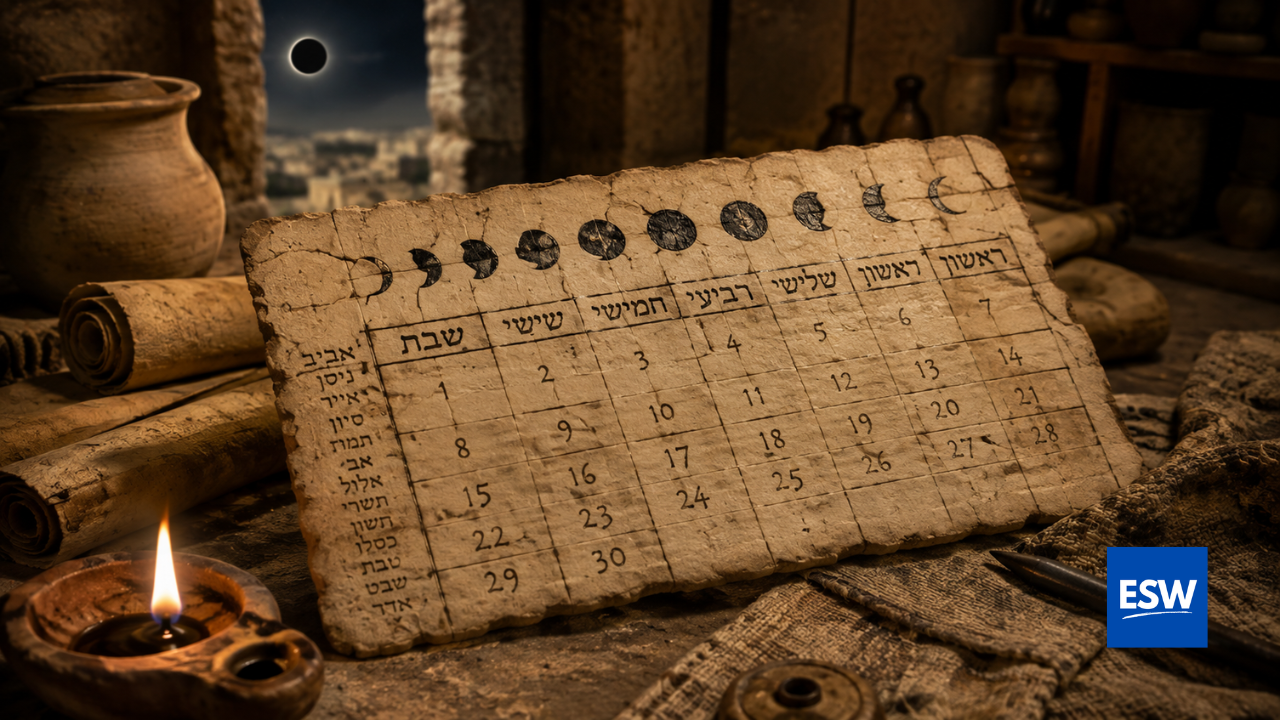
Beginning of Each Biblical Month
Each entry marks Day 1 using this calendar’s Jerusalem conjunction rule: a conjunction during the night begins Day 1 with that same night; a conjunction during daylight begins Day 1 at the following sundown. Month 1 is identified as Aviv/Abib (Deuteronomy 16:1). The Torah gives a work restriction for Day 1 of Month 7; it does not state a general work prohibition for every beginning of a month.
Rosh Chodesh — Biblical Month 1 (Aviv/Abib)
Thursday, March 19, 2026
Begins at Sundown: Wed, Mar 18 · 5:48 PM IST → Thu, Mar 19 · 5:49 PM IST (Jerusalem)
Jerusalem conjunction (~0%): Thu, Mar 19 · 3:25 AM IST
Rosh Chodesh — Biblical Month 2
Saturday, April 18, 2026
Begins at Sundown: Fri, Apr 17 · 7:09 PM IDT → Sat, Apr 18 · 7:09 PM IDT (Jerusalem)
Jerusalem conjunction (~0%): Fri, Apr 17 · 2:54 PM IDT
Rosh Chodesh — Biblical Month 3
Sunday, May 17, 2026
Begins at Sundown: Sat, May 16 · 7:29 PM IDT → Sun, May 17 · 7:30 PM IDT (Jerusalem)
Jerusalem conjunction (~0%): Sat, May 16 · 11:03 PM IDT
Rosh Chodesh — Biblical Month 4
Tuesday, June 16, 2026
Begins at Sundown: Mon, Jun 15 · 7:46 PM IDT → Tue, Jun 16 · 7:46 PM IDT (Jerusalem)
Jerusalem conjunction (~0%): Mon, Jun 15 · 5:56 AM IDT
Rosh Chodesh — Biblical Month 5
Wednesday, July 15, 2026
Begins at Sundown: Tue, Jul 14 · 7:46 PM IDT → Wed, Jul 15 · 7:45 PM IDT (Jerusalem)
Jerusalem conjunction (~0%): Tue, Jul 14 · 12:45 PM IDT
Rosh Chodesh — Biblical Month 6
Thursday, August 13, 2026
Begins at Sundown: Wed, Aug 12 · 7:26 PM IDT → Thu, Aug 13 · 7:25 PM IDT (Jerusalem)
Jerusalem conjunction (~0%): Wed, Aug 12 · 8:38 PM IDT
Rosh Chodesh — Biblical Month 7
Saturday, September 12, 2026
Begins at Sundown: Fri, Sep 11 · 6:50 PM IDT → Sat, Sep 12 · 6:49 PM IDT (Jerusalem)
Jerusalem conjunction (~0%): Fri, Sep 11 · 6:28 AM IDT
Rosh Chodesh — Biblical Month 8
Sunday, October 11, 2026
Begins at Sundown: Sat, Oct 10 · 6:13 PM IDT → Sun, Oct 11 · 6:12 PM IDT (Jerusalem)
Jerusalem conjunction (~0%): Sat, Oct 10 · 6:51 PM IDT
Rosh Chodesh — Biblical Month 9
Tuesday, November 10, 2026
Begins at Sundown: Mon, Nov 9 · 4:43 PM IST → Tue, Nov 10 · 4:43 PM IST (Jerusalem)
Jerusalem conjunction (~0%): Mon, Nov 9 · 9:03 AM IST
Rosh Chodesh — Biblical Month 10
Wednesday, December 9, 2026
Begins at Sundown: Tue, Dec 8 · 4:35 PM IST → Wed, Dec 9 · 4:35 PM IST (Jerusalem)
Jerusalem conjunction (~0%): Wed, Dec 9 · 2:53 AM IST
Rosh Chodesh — Biblical Month 11
Friday, January 8, 2027
Begins at Sundown: Thu, Jan 7 · 4:50 PM IST → Fri, Jan 8 · 4:51 PM IST (Jerusalem)
Jerusalem conjunction (~0%): Thu, Jan 7 · 10:26 PM IST
Rosh Chodesh — Biblical Month 12
Sunday, February 7, 2027
Begins at Sundown: Sat, Feb 6 · 5:17 PM IST → Sun, Feb 7 · 5:18 PM IST (Jerusalem)
Jerusalem conjunction (~0%): Sat, Feb 6 · 5:57 PM IST
Work-Rest Guidance
Work restrictions: Hag Matzot (Feast of Unleavened Bread) Days 1 and 7, Shavuot (Feast of Weeks), Yom Teruah (Feast of Trumpets) on Month 7 Day 1, Sukkot (Feast of Tabernacles) Day 1, and Shemini Atzeret (Eighth-Day Assembly) prohibit servile/customary work. The Day of Atonement is stricter: Leviticus 23:28 commands that no work be done. Pesach (Passover) on Day 14 and the wave-sheaf day do not contain an express feast-day work prohibition in Leviticus 23. Sukkot (Feast of Tabernacles) Day 7 is likewise not identified there as a no-work day; the prohibitions apply to Day 1 and Day 8.
Work timing: The civil date shown with WORK NOT PERMITTED is the daytime date contained within the sundown-to-sundown biblical day. Anyone whose work shift extends past sundown on the preceding civil date should also account for that portion of the previous evening.
Spring Feasts
Pesach (Passover)
Month 1 · Day 14
Work instruction: No express feast-day work prohibition is stated for Passover Day 14 in Leviticus 23.
The Passover sacrifice is on the fourteenth day between the evenings. The Feast of Unleavened Bread begins as Day 15 starts at sunset.
Scripture: Leviticus 23:5; Exodus 12:6
Hag Matzot (Feast of Unleavened Bread) — Day 1
WORK NOT PERMITTEDMonth 1 · Day 15
Work instruction: No servile/customary work.
First day of the seven-day Feast of Unleavened Bread.
Scripture: Leviticus 23:6–7; Numbers 28:17–18
Yom HaBikurim (Feast of Firstfruits)
Day after the weekly Sabbath during Unleavened Bread
Work instruction: No express feast-day work prohibition is stated for the wave-sheaf day in Leviticus 23.
In this calendar, “the Sabbath” is read as the weekly Sabbath that occurs during Unleavened Bread.
Scripture: Leviticus 23:10–16
Hag Matzot (Feast of Unleavened Bread) — Day 7
WORK NOT PERMITTEDMonth 1 · Day 21
Work instruction: No servile/customary work.
Seventh and final day of the Feast of Unleavened Bread.
Scripture: Leviticus 23:6–8; Numbers 28:25
Shavuot (Feast of Weeks)
WORK NOT PERMITTEDFiftieth day from Firstfruits
Work instruction: No servile/customary work.
Count seven complete weekly Sabbaths; the day after the seventh Sabbath is the fiftieth day.
Scripture: Leviticus 23:15–21; Deuteronomy 16:9–10
Autumn Feasts
Yom Teruah (Feast of Trumpets)
WORK NOT PERMITTEDMonth 7 · Day 1
Work instruction: No servile/customary work.
A solemn rest, memorial of blowing, and holy convocation.
Scripture: Leviticus 23:23–25; Numbers 29:1
Yom Kippur (Day of Atonement)
WORK NOT PERMITTEDMonth 7 · Day 10
Work instruction: No work. This is stated more strongly than “no servile work.”
Afflict yourselves; Leviticus 23:32 expressly gives the observance from evening to evening.
Scripture: Leviticus 23:26–32; Numbers 29:7
Sukkot (Feast of Tabernacles) — Day 1
WORK NOT PERMITTEDMonth 7 · Day 15
Work instruction: No servile/customary work.
First day of the seven-day Feast of Tabernacles.
Scripture: Leviticus 23:33–36, 39
Sukkot (Feast of Tabernacles) — Day 7
Month 7 · Day 21
Work instruction: No express feast-day work prohibition is stated for Day 7 in Leviticus 23.
The seven-day Feast of Tabernacles concludes; the commanded rest assembly follows on Day 8.
Scripture: Leviticus 23:34–36, 39–43
Shemini Atzeret (Eighth-Day Assembly)
WORK NOT PERMITTEDMonth 7 · Day 22
Work instruction: No servile/customary work.
The solemn assembly on the eighth day following the seven days of Sukkot.
Scripture: Leviticus 23:36, 39; Numbers 29:35
Generated by ESW · ESW WordPress Plugins