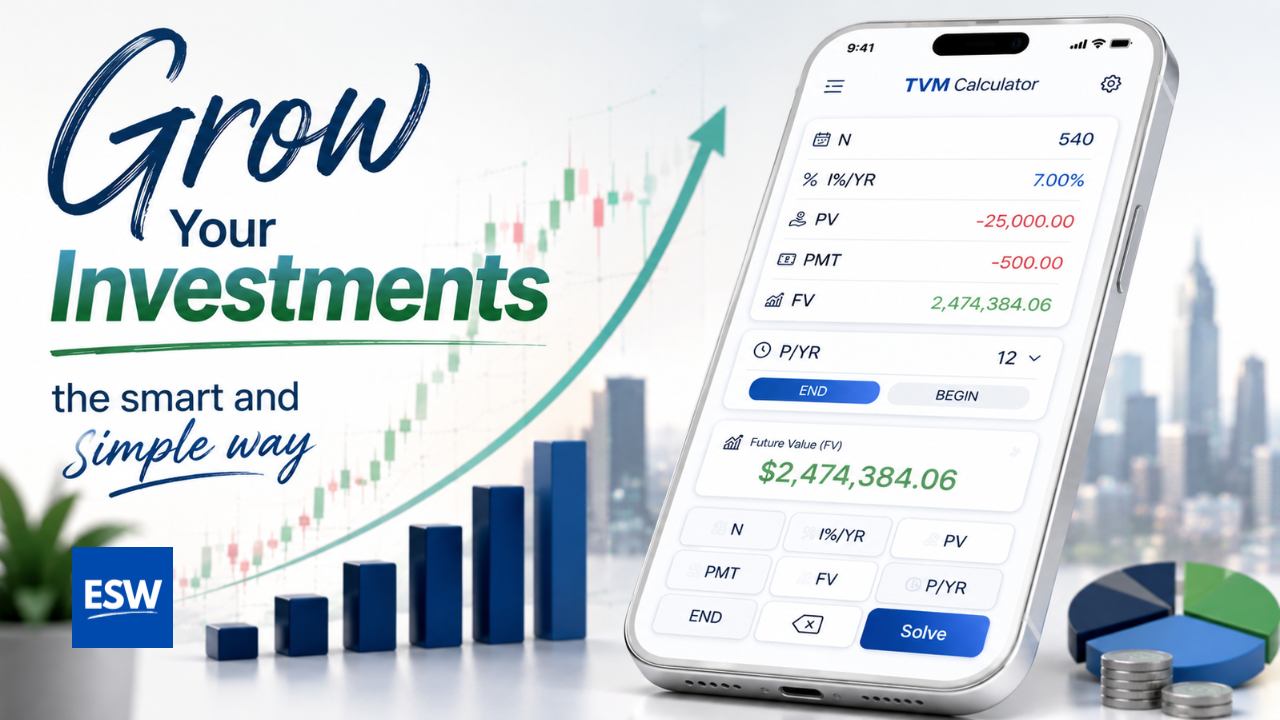
Building financial freedom doesn’t have to be complicated. These calculators are designed to help you better understand how everyday financial decisions—saving, eliminating debt, investing consistently, buying a home, and preparing for retirement—can affect your financial future.
Use them to experiment with different numbers and scenarios. Sometimes changing just one variable—investing a little more each month, eliminating high-interest debt sooner, or starting a few years earlier—can make a surprisingly large difference over time.
Calculators Included
Frugality Calculator
Discover how small, everyday spending decisions can have a surprisingly large long-term impact. See how much money you could reclaim by reducing or eliminating unnecessary expenses—and what those savings could potentially become when redirected toward debt elimination, an emergency fund, or long-term investing.
Investment Growth Calculator
See how an initial investment and regular monthly contributions could grow over time through the power of compounding.
Retirement Calculator
Estimate how much you could accumulate by retirement and how that portfolio might translate into potential retirement income.
Debt Payoff Calculator
See how your monthly payments and interest rate affect how long it takes to eliminate debt—and how much interest that debt could ultimately cost you.
Debt Snowball & Avalanche Calculator
Create a clear path toward becoming debt-free. Enter your credit cards, personal loans, car loans, or other debts and compare the Debt Snowball method—paying the smallest balance first—with the Debt Avalanche method—prioritizing the highest interest rate. See your recommended payoff order, estimated payoff dates, total interest, and how adding extra money or making payments more frequently could help you get out of debt faster and save money on interest.
Mortgage Calculator
Estimate the true monthly cost of a home, including principal and interest, property taxes, homeowners insurance, and HOA fees.
4% Rule Calculator
Explore how an investment portfolio could potentially translate into annual, monthly, and weekly retirement income using a selected withdrawal rate.
How Long Until $1 Million? Calculator
Enter your current investments, monthly contributions, and assumed return to estimate how long it could take to reach $1 million—or another financial goal.
Time Value of Money (TVM) Calculator
Discover what your money is worth today, tomorrow, or years into the future. The TVM Calculator lets you solve for Present Value (PV), Future Value (FV), Payments (PMT), Interest Rate (I%YR), or Number of Periods (N) by entering the values you already know. It’s a powerful way to explore investment growth, savings goals, loans, and other financial scenarios—and better understand how time, interest, and consistent contributions can dramatically affect your financial future.
These calculators are educational tools, not predictions. Their real value is in helping you understand the relationship between debt, saving, time, consistency, investing, and compound growth so you can make more informed financial decisions.
Frugality Calculator
Small expenses can add up to surprisingly large amounts over a lifetime. This calculator helps you discover how much money you could potentially reclaim by reducing or eliminating unnecessary expenses—and what that money could become if redirected toward debt elimination, savings, or long-term investing.
The default 45-year investment period represents a person starting at age 20 and investing until age 65, illustrating how seemingly small financial decisions made today can have a significant impact over an entire working lifetime.
Frugality isn’t about depriving yourself. It’s about spending intentionally and giving more of your hard-earned money a better purpose.
Frugality Calculator
See how much money you could reclaim by reducing everyday expenses—and what that money could potentially become if you redirect it toward your financial future.
Your expenses
Add spending you may want to reduce or eliminate.
What if you invested the savings instead?
Explore the potential long-term effect of consistently investing the money you reclaim.
A broad-market ETF such as VTI is one example of a diversified long-term investment approach. Actual returns vary, losses are possible, and no future return is guaranteed.
Where could this money go instead?
A simple order of priorities
- Build a basic emergency fund. Consider roughly $1,000–$3,000 so an unexpected expense does not immediately push you into debt.
- Attack high-interest consumer debt. Credit-card interest can overwhelm the potential return of long-term investments.
- Strengthen your financial cushion. Build toward a larger emergency reserve appropriate for your situation.
- Redirect savings toward long-term goals. Once your foundation is stronger, consistent investing can allow compounding to work in your favor.
For educational purposes only. Results are estimates and do not constitute financial, investment, tax, legal, or debt-management advice. Investment returns are not guaranteed.
Investment Growth Calculator
Why it matters: Small, consistent investments can grow substantially over time because of compound growth. This calculator helps you visualize how your starting balance, monthly contributions, time, and expected rate of return can work together to build wealth.
Key considerations: Investment returns are never guaranteed, and actual results will fluctuate from year to year. Pay particular attention to the impact of time, consistent contributions, and inflation. Even relatively small changes in the assumed rate of return can make a significant difference over long periods.
Investment Growth Calculator
Estimate how recurring contributions and compound growth may build wealth over time.
For educational purposes only. Results are estimates and do not constitute financial, investment, tax, legal, or lending advice.
Retirement Calculator
Why it matters: Retirement planning is not only about how much you save, but also how much time your money has to grow and how much income your savings may eventually provide. This calculator helps estimate the value of your investments at retirement and the potential income they could support.
Key considerations: Your future results will depend on investment performance, contribution amounts, retirement age, inflation, taxes, and your withdrawal strategy. The withdrawal estimate should be viewed as a planning tool rather than a guarantee that your money will last throughout retirement.
Retirement Calculator
Estimate your retirement balance and a possible annual withdrawal amount.
For educational purposes only. Results are estimates and do not constitute financial, investment, tax, legal, or lending advice.
Debt Payoff Calculator
Why it matters: Avoiding unnecessary debt—and especially high-interest credit card debt—is one of the most important steps you can take before trying to build long-term wealth through investing.
The reason is fairly simple. A broadly diversified stock-market ETF such as VTI has historically produced strong long-term returns, with roughly 8–10% per year being a useful historical illustration depending on the period measured. But those returns are never guaranteed.
Credit card interest, on the other hand, may be 18%, 25%, 30%, or even higher—and unlike an investment return, that interest is working against you.
Think about the math. If you’re hoping to earn an average of 8–10% by investing while simultaneously paying 25% interest on credit card debt, the much higher cost of the debt can overwhelm the potential growth of your investments. That’s why eliminating high-interest debt can effectively become one of your best financial “returns.”
But before aggressively paying off debt, build a small emergency fund. Consider setting aside approximately $1,000 to $3,000 as a basic financial cushion. The purpose isn’t to create your complete emergency fund yet; it’s to prevent an unexpected expense from immediately sending you back into debt.
For example, imagine you’re aggressively paying down your credit cards and suddenly your car’s transmission fails. Without any emergency savings, you may have no choice but to put the repair right back on the credit card you were trying to eliminate.
A simple order of priorities could therefore look like this:
1. Build a basic $1,000–$3,000 emergency fund → 2. Aggressively eliminate high-interest credit card debt → 3. Build a stronger financial foundation → 4. Begin or increase long-term investing.
If you’re wondering how to tackle multiple credit cards and where to begin, I’ve explained a simple debt-payoff strategy [here].
Key considerations: Not every type of debt should necessarily be treated the same way. A low-interest mortgage, for example, presents a very different financial decision from a credit card charging 25–30%. Also consider whether your employer offers a retirement-plan match, since giving up an available employer match while paying debt can change the calculation.
The goal isn’t simply to become debt-free. It’s to stop paying high interest to someone else so that eventually compound growth can start working for you instead of compound interest working against you.
Debt Payoff Calculator
Estimate how long it may take to pay off a debt with a fixed monthly payment.
For educational purposes only. Results are estimates and do not constitute financial, investment, tax, legal, or lending advice.
Build Your Personal Debt-Free Plan
Getting out of debt is easier when you have a clear plan and know exactly which debt to attack first. This calculator helps you organize your credit cards, personal loans, car loans, and other debts into a simple step-by-step payoff strategy.
Choose between the Debt Snowball, which targets the smallest balance first to build momentum, or the Debt Avalanche, which targets the highest interest rate first to potentially save more money on interest.
Enter the balance, interest rate, and minimum payment for each debt, along with any extra monthly amount you can contribute. The calculator will estimate your payoff order, when each debt could be eliminated, your overall debt-free date, and the total interest you may pay.
The key is simple: continue making at least the minimum payment on every debt while putting your extra money toward one target at a time. Once that debt is gone, roll the money you were paying toward it into the next one. As each debt disappears, your payment power grows.
Tip: This calculator is based on monthly payments. Making weekly or even daily payments instead of waiting to pay once a month may help reduce the total interest you pay and get you out of debt a little sooner.
Privacy: The information you enter is not stored or shared. Calculations happen only in your browser, and your information disappears when the page is refreshed or closed.
Snowball Debt Calculator
Build a simple payoff plan for credit cards, personal loans, car loans, and other debts. Keep paying the minimum on every debt while directing your extra money toward one target at a time.
Your debts
Start with two debts and add as many more as you need.
Payoff order
How the plan works
Continue making at least the minimum payment on every active debt. Your extra monthly amount goes to the current target debt. When that debt is paid off, the money that had been going toward it is rolled into the next debt, creating an increasingly larger payment.
Your information stays on your device
This calculator does not send, store, or share the debt information you enter. Calculations happen locally in your browser. If you refresh or leave the page, the information is cleared unless you personally save the downloadable summary.
For educational purposes only. Payoff dates and interest estimates may differ from lender calculations because of statement dates, daily interest, fees, changing minimum payments, promotional rates, late payments, and other account-specific terms. This calculator does not provide financial, legal, tax, lending, or debt-management advice.
Mortgage Calculator
Why it matters: The price of a home does not tell you what it will actually cost each month. This calculator estimates your mortgage payment while also accounting for expenses such as property taxes, homeowners insurance, and HOA fees.
Key considerations: Your actual housing cost may also include mortgage insurance, maintenance, repairs, utilities, closing costs, and changing taxes or insurance premiums. A lender’s approval amount is not necessarily the same as what comfortably fits your personal budget.
Mortgage Calculator
Estimate monthly principal and interest plus common housing costs.
For educational purposes only. Results are estimates and do not constitute financial, investment, tax, legal, or lending advice.
4% Rule Calculator
Why it matters: Building a large investment portfolio is only part of retirement planning—you also need to understand how that portfolio might translate into income. This calculator uses a selected withdrawal rate, commonly 4%, to estimate how much you could initially withdraw annually, monthly, and weekly.
Key considerations: The 4% rule is a retirement-planning guideline, not a guarantee. Market performance, inflation, taxes, retirement length, portfolio allocation, and the timing of market downturns can all affect how long your money lasts.
4% Rule Calculator
Estimate a first-year withdrawal amount using a chosen withdrawal rate.
For educational purposes only. Results are estimates and do not constitute financial, investment, tax, legal, or lending advice.
“How Long Until $1 Million?” Calculator
Why it matters: A large financial goal can feel overwhelming until you break it down into time, contributions, and compound growth. This calculator estimates how long it could take to reach $1 million—or another target—based on what you already have, how much you invest each month, and your assumed return.
Key considerations: The most powerful variables are often time and consistency. Starting earlier gives compound growth more time to work, while increasing your regular contributions can dramatically shorten the journey. Remember that the assumed investment return is only an estimate and actual market returns will vary.
How Long Until $1 Million?
Estimate how long it may take to reach a savings or investment target.
For educational purposes only. Results are estimates and do not constitute financial, investment, tax, legal, or lending advice.
One Calculator, Many Financial Questions
The Time Value of Money (TVM) Calculator is one of the most versatile financial tools on this page and can be used as an alternative to several of the calculators above. You can use it to explore investments, retirement savings, loans, credit-card payoff scenarios, and much more. Simply enter four of the five values—N, I%YR, PV, PMT, and FV—and solve for the one you want to know.
One important thing to understand is the use of positive (+) and negative (−) numbers. Think of a negative number as money going out of your pocket and a positive number as money coming back to you.
For example, when calculating retirement savings, your starting investment (PV) and monthly contributions (PMT) would normally be entered as negative numbers because you are putting that money into the investment. Your future retirement balance (FV) would then be positive.
For a credit-card payoff calculation, the signs work the opposite way. Your current credit-card balance (PV) can be entered as a positive amount because it represents money previously borrowed, while your monthly payments (PMT) are negative because that money is leaving your pocket. If your goal is to completely pay off the card, enter FV = 0 and solve for N to estimate how many payments it will take.
Not sure how to enter everything? Click Load Example to see the calculator working with sample values. This can also be helpful on smartphones where the numeric keyboard may not make it easy to enter the minus (−) symbol directly. Load the example first, then edit the negative value already provided as needed.
Tip: The most important rule is that money flowing in and money flowing out should have opposite signs.
Time Value of Money Calculator
Enter the values you already know in any order, then press Solve on the variable you want to calculate.
How to use it
Use the same cash-flow sign convention used by financial calculators: money you pay out is normally negative, while money you receive is positive.
N is total payment periods. I%YR is nominal annual interest rate. PV is present value, PMT is recurring payment, and FV is future value.
For educational purposes only. Results are estimates and do not constitute financial, investment, lending, tax, or legal advice. This plugin is independently developed and is not affiliated with or endorsed by HP.
A Final Thought
Thank you for taking the time to explore these financial calculators. I hope they help you better understand your money, make more informed decisions, eliminate debt, and build a stronger financial future.
These calculators are meant to be tools for learning and planning, not a substitute for professional financial advice. Take what is useful. Test the numbers. Explore different scenarios. Stay curious. And most importantly, keep thinking for yourself.
I’m just a regular guy sharing what I’ve learned, questioned, experienced, and observed along the way. If you ever want to connect, ask a question, challenge an idea, or simply share your own perspective, feel free to reach out at edsilvaworld@pm.me.
Want One of These Calculators on Your WordPress Website?
I created the WordPress plugins that power the calculators on this page. If you would like to use any of these plugins on your own WordPress website, or would like to know more about them, send me an email at edsilvaworld@pm.me.
Sometimes a simple tool can help us see our finances differently, and sometimes a simple conversation can change the direction of someone’s life.
Eduardo
Recommended reading: How to Get Out of Debt Quickly and The Simple Path to Wealth.