Is Rideshare Still Worth It?
Is Rideshare Really Worth It for You?
Long-time drivers have seen how much rideshare has changed. Today, simply looking at what Uber or Lyft pays you doesn’t necessarily tell you whether you’re actually making money.
Gross pay isn’t profit. Your vehicle has operating costs, unpaid miles add up, and your time has value too.
And there may be another reason to pay closer attention to the numbers. In an investigation by More Perfect Union, research by Len Sherman of Columbia Business School illustrates a widening gap between what passengers pay and what drivers receive. Sherman has estimated that Uber’s share of fares has increased substantially in recent years, although Uber disputes that characterization and says costs such as commercial insurance are an important part of the difference.
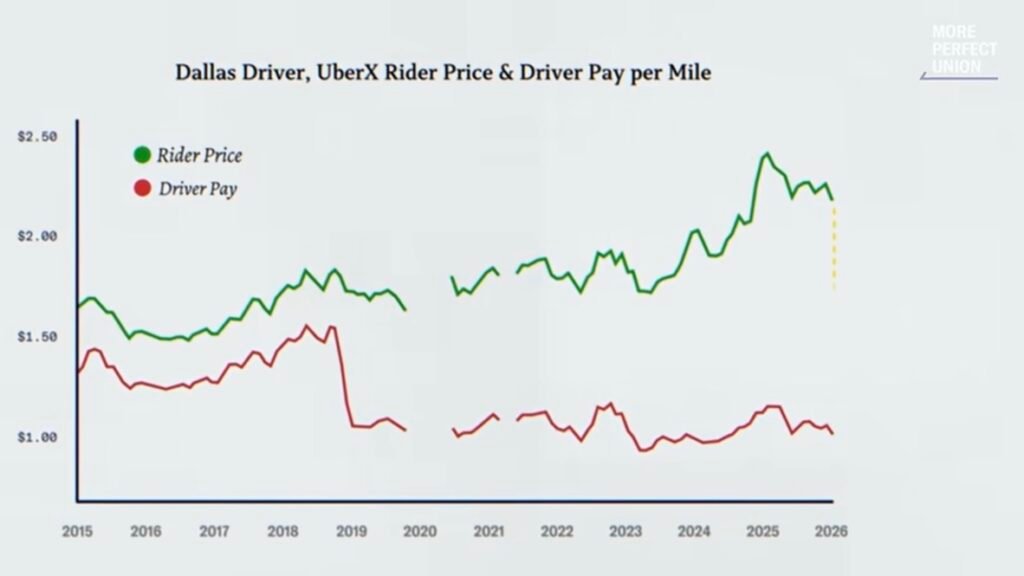
Watch the More Perfect Union video around 5:29 to see the chart and explanation: Watch video.
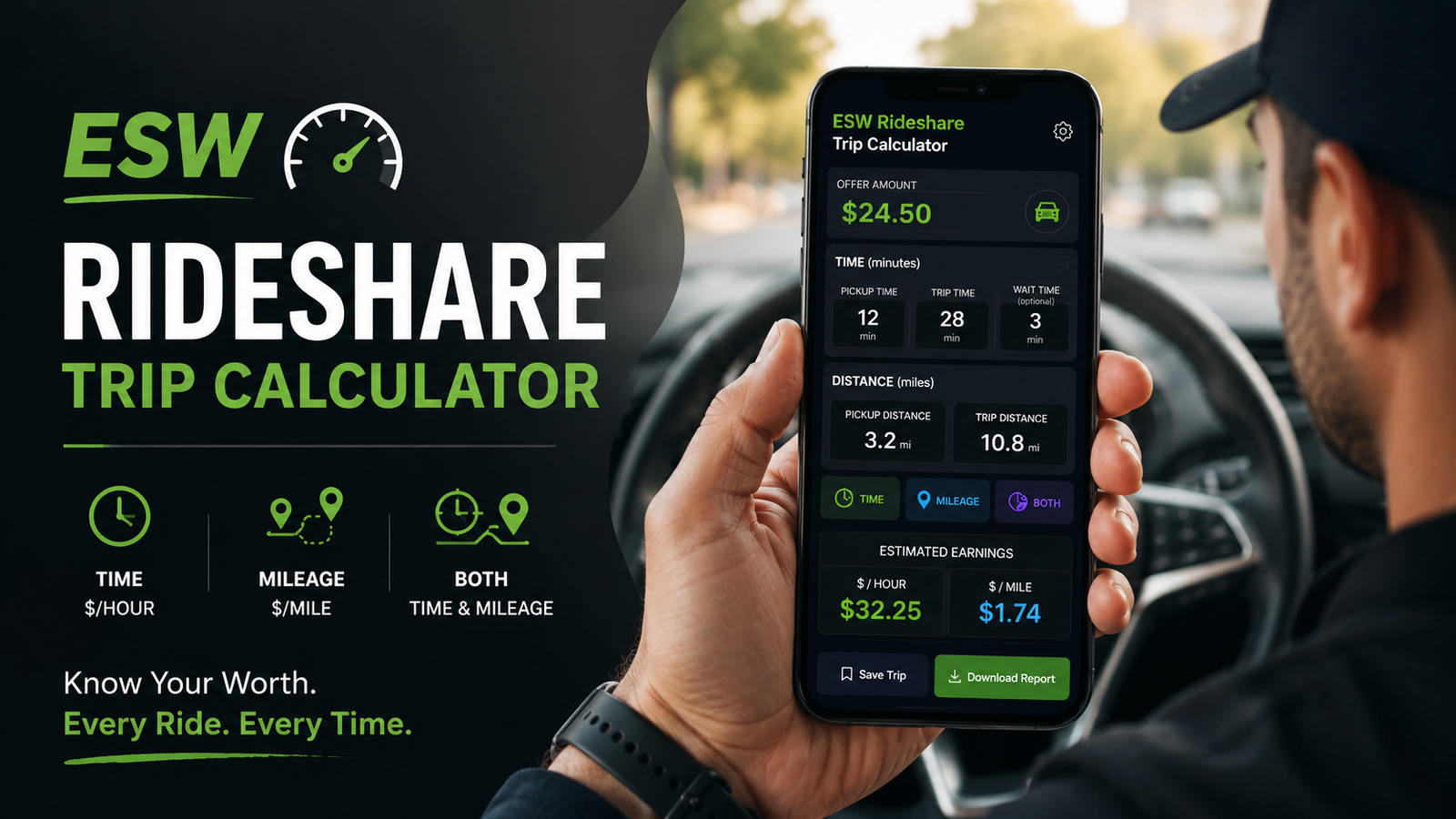
That’s why I created the ESW Rideshare Trip Profitability Calculator and the ESW Rideshare True Operating Cost Calculator: to help drivers look beyond gross earnings and get a clearer picture of what their rides and workday may actually be worth.
Every driver, vehicle, and market is different. Your numbers may show that you’re doing great, that a few changes could improve your results—or that rideshare may no longer be worth your time.
The goal isn’t to convince you to drive or to quit. It’s to give you better information to decide for yourself.
There’s only one way to know: follow the numbers.

Full-Time Rideshare Driver Since 2017
Rideshare Without the Sugarcoating
I’ve been driving rideshare full-time since 2017. I’ve seen good days, terrible days, changing pay structures, difficult passengers, accidents, traffic, long airport waits, expensive vehicle costs—and yes, days when the money was very good.
So if you’re thinking about driving for Uber, Lyft, or another rideshare company, here are a few things I wish every new driver understood before jumping in.
Don’t buy a brand-new car just to do rideshare. If you already have a reliable vehicle that qualifies, start with what you have. If you need to buy one, consider a reliable used vehicle a few years old rather than taking on a large new-car payment for a business that puts enormous mileage and depreciation on vehicles.
Try rideshare before building your life around it. Start part-time if you can. Learn your market, different times of day, traffic patterns, airport behavior, and what rides actually work for you before making major financial decisions based on what you think you’ll earn.
Don’t confuse gross earnings with profit. Making $200 doesn’t mean you made $200. Your vehicle had to produce that money. Fuel or charging, maintenance, tires, depreciation, insurance, rental costs, empty mileage and other operating expenses matter. Know your cost per mile. Calculate your here.
Don’t confuse a great day with normal earnings. Drivers love talking about that amazing $300 or $400 day. The better question is: What do you consistently average over many ordinary days—and how many hours and miles does it take? One exceptional screenshot doesn’t tell you what the business normally produces.
Be skeptical of impressive weekly earnings without knowing the hours. Yes, some drivers consistently gross $2,000, $2,500, $3,000 or more. But ask the second question: How much time did it take? Someone working seven days a week and spending 14–16 hours a day around rideshare can generate an impressive weekly number while earning a much less impressive amount for every hour of their life committed to producing it.
The airport isn’t automatically where the money is. An airport trip can be excellent. Sitting in an airport queue for a long time waiting for one may not be. Count the waiting time and empty mileage—not just the fare you eventually receive.
Your highest-paying ride isn’t necessarily your most profitable ride. A $40 offer with a long pickup, heavy traffic and lots of miles may be worse than several smaller rides. Evaluate offers by time and mileage, not just dollars.
Unpaid miles still cost money. Driving toward a better area, returning from a distant drop-off, repositioning, heading to a charger, or driving around waiting for work may produce zero revenue, but the vehicle is still accumulating miles and costs.
Your time counts even when a passenger isn’t in the car. Charging, fueling, cleaning, waiting for requests and other necessary rideshare tasks consume part of your day. That’s why I distinguish between the rate produced by the rides themselves and what you actually earned for your entire rideshare commitment.
Flexibility has real value—but don’t let it hide poor economics. Being able to work whenever you want is one of rideshare’s greatest advantages. That freedom may genuinely be worth something to you. But flexibility doesn’t turn an unprofitable business into a profitable one.
Don’t Depend on Just One App. Using multiple gig apps can give you more opportunities and reduce the time you spend waiting for the next worthwhile offer. In addition to Uber and Lyft, consider food delivery, grocery shopping and delivery, package delivery, or other legitimate gig platforms available in your market. The goal isn’t to stay constantly busy—it’s to have more options so you can be more selective. Compare the time, mileage, effort, and actual profitability of each opportunity, and let the numbers determine which one deserves your time.
Be careful with incentives and gamification. Gig apps are designed to keep drivers engaged. Streaks, bonuses, status levels, notifications, maps, goals and other incentives can influence when and how long you drive. Treat them as business information—not instructions. A bonus isn’t valuable if chasing it causes you to accept bad rides or work hours that don’t make economic sense.
Low Offers and the Algorithm. The more low-paying offers drivers accept, the more evidence the algorithm has that those offers can successfully get a driver at that price. While we don’t know exactly how Uber or Lyft’s proprietary algorithms determine each offer, there is little reason for a platform to voluntarily pay more when drivers consistently accept less. You can’t control the algorithm or what it sends you, but you can control what you accept. Know your minimums, follow the numbers, and remember: staying busy doesn’t necessarily mean being profitable.
Quick money can become difficult to walk away from. That’s another part people rarely discuss. You can turn on an app and potentially start earning almost immediately. That convenience and flexibility can make rideshare psychologically hard to leave even when the numbers aren’t as attractive as they once were. Periodically ask yourself whether you’re still driving because it makes financial sense—or simply because you’ve become accustomed to doing it.
Don’t assume the platform’s interests and yours are the same. Uber and Lyft operate businesses, just as you should treat your driving as a business. Their objective is not necessarily to maximize your earnings. Your responsibility is to decide what offers, hours and conditions make sense for you.
Autonomous Vehicles Are Part of the Equation. Autonomous vehicles are no longer just a distant possibility—they are becoming part of the rideshare business. Uber, Lyft, and other companies have strong financial incentives to reduce the cost of providing each ride, and human drivers represent a significant part of that cost. Nobody knows how quickly autonomous vehicles will expand or how much they will ultimately affect driver opportunities, but if rideshare is a major source of your income, it makes sense to treat it as a business that could change dramatically rather than assuming today’s opportunities will always be there.
Don’t Assume Your Personal Insurance Covers Rideshare. If you drive for Uber, Lyft, or another rideshare platform, make sure your auto insurer knows how the vehicle is being used and ask whether you need a TNC/rideshare endorsement. A standard personal policy may exclude or limit coverage during certain periods of rideshare activity, while the platform’s insurance may not cover every situation the way you expect. That can create potentially expensive coverage gaps after an accident. Don’t wait until something happens to find out what is—and isn’t—covered. Review your policy, tell your insurer you drive rideshare, and get the appropriate coverage for your situation.
Safety comes before the next ride. No fare is worth an accident. Don’t operate calculators or other distracting tools while moving. Fatigue matters too. Extremely long driving days may produce bigger gross numbers, but traffic, passengers, weather and exhaustion increase the risks of spending that many hours behind the wheel.
Cash Rides Aren’t Worth the Risk. It can be tempting when a passenger offers cash for a ride outside Uber, Lyft, or another rideshare platform—especially when you realize how much of the fare you could keep. But that extra money can come with enormous risk. Once you take a passenger outside the platform, you may no longer have the insurance protections provided during an authorized rideshare trip, and your personal auto policy may not cover commercial passenger transportation either. If there’s a serious accident and your passenger is injured, the potential medical costs and personal liability could dwarf anything you ever made from cash rides. A few extra dollars are not worth putting your financial future at risk.
And finally:
Know when enough is enough.
Rideshare doesn’t have to be either “This is my career forever” or “I quit.” It can be full-time, part-time, supplemental income, something you do temporarily, or something you eventually stop doing altogether.
Treat it like a business. Know your cost per mile. Track your time. Watch your unpaid mileage. Understand what you’re actually keeping after expenses. Look at several representative days instead of your best day.
Then ask yourself a very simple question:
If I knew before starting today exactly how much money, time, mileage, vehicle wear and stress this day would require, would I still choose to do it?
If the answer is yes, great.
If the answer keeps becoming no, don’t ignore what your own numbers are telling you.
No hype. No bragging screenshots. No sugarcoating. Just follow the numbers.
Already Using GigU or Gridwise?
If you already use GigU or Gridwise, that’s great—I use them too.
So why would you also use the ESW Rideshare Trip Profitability Calculator?
Because these tools can complement each other.
GigU can automatically help you evaluate incoming ride requests based on your preferences. Gridwise offers useful features such as automatic mileage tracking, expense tracking, earnings information, and other driver insights.
This trip calculator serves a different purpose: it helps you take a closer look at individual rides and your overall workday using your own profitability targets, operating cost per mile, time, mileage, empty driving, and optional tax reserve.
Use It Your Way
If you don’t already use something like GigU to evaluate incoming offers, you can use this calculator to quickly evaluate a request By Time, By Mileage, or Both. Based on the Ideal and Minimum Acceptable Rates you set, you’ll get a simple green, yellow, or red evaluation.
You don’t necessarily need to complete every field. Enter whatever information is available and use the calculation that makes sense.
But you don’t have to use the calculator with live ride requests at all.
You can continue using GigU for that—or simply focus on driving—and later go through your Uber or Lyft ride history and enter the rides you actually completed. Do it while safely parked, during a break, or at the end of the day.
This lets you ask a different question:
Not just “Should I accept this ride?” but “Was this ride actually worth it?”
Look Beyond the Rides
Even if you never use this calculator to evaluate an incoming offer, you can still use its Workday Timer to track how your day is being spent and record unpaid or empty driving such as repositioning or driving to fuel or charge.
Those empty miles matter because they’re still putting costs and wear on your vehicle even when you’re not carrying a passenger.
If you know your operating cost per mile, the calculator can estimate what those miles are costing you.
Don’t know your cost per mile? That’s what the ESW Rideshare True Operating Cost Calculator is for. It helps you consider the costs of operating your particular vehicle and turn them into an estimated cost per mile.
Neither calculator is intended to be a daily expense tracker. You don’t enter every tank of gas, charging session, car wash, repair, or other purchase every day. The cost-per-mile calculator helps you establish that important number; this trip calculator then uses it to help analyze the miles you drive.
We’re not trying to track every dollar you spend. We’re trying to understand what every mile costs you—and what your rideshare earnings are really worth.
See the Whole Day
As you save completed rides, record empty mileage, and use the Workday Timer, the Daily Analysis brings that information together.
Add an optional tax reserve in Driver Preferences, and you can look beyond gross earnings to better understand what may remain after estimated vehicle operating costs and your tax reserve.
You don’t have to do this every day. Try it for a few days, a week, or however long it takes to understand your patterns.
You may discover that you’re doing great. You may find opportunities to reduce empty miles, avoid long pickups, work different hours, or become more selective. Or the numbers may tell you something more important: rideshare isn’t as profitable as you thought.
That’s the purpose of this calculator.
Use the tools that work for you—but know your numbers.
A Safer Way to Select Profitable Rides
The best approach I’ve found is to go offline after accepting a ride request. Once I drop off the passenger, I go back online and, while safely parked, use the calculator to evaluate the next request.
This gives me time to look at the numbers and decide whether a ride makes sense without trying to use the calculator while driving. If I accept the ride, I go offline again until the trip is completed, then repeat the process.
Never use this calculator while your vehicle is moving. No ride is worth risking your safety or the safety of others just to evaluate a few numbers.
Using the calculator this way has helped me become more selective, make better-informed decisions, reduce unnecessary driving, and focus on rides that make better sense for my time and mileage—all while keeping safety first.
How to Use This Calculator
The ESW Rideshare Trip Profitability Calculator helps you evaluate individual rides and get a broader picture of your rideshare workday.
Start with Driver Preferences. Enter your Ideal and Minimum Acceptable earnings per hour and per mile. If you know your vehicle’s operating cost per mile, enter that too, along with an optional tax reserve. These settings allow the calculator to compare rides against the standards that matter to you.
IMPORTANT. Make sure to reload the web page from time to time to ensure you’re using the most recent version of the app.
Evaluate a Ride
Enter the ride offer along with the available pickup and trip information. You can calculate the ride By Time, By Mileage, or Both, so you don’t necessarily need every piece of information to get a quick evaluation.
When evaluating a live request, speed matters. For example, instead of entering $18.73, you might simply enter $19 for a quick estimate.
Never enter information while your vehicle is moving. If there isn’t enough time to safely evaluate a request, you can always enter the completed ride later from your Uber or Lyft trip history.
Complete the Ride Later
Some information isn’t known when the original offer appears.
If you had to wait for the passenger, add the waiting time afterward to see how it affected the ride’s actual hourly earnings.
If you receive a tip, add it to the saved ride. The tip is included in the final earnings and profitability calculations without changing the original green, yellow, or red evaluation of the offer.
Save completed rides whenever you want them included in your Daily Analysis.
Track the Rest of Your Workday
Individual rides don’t tell the whole story.
Use the Workday Timer to record time spent working, taking breaks, working on personal projects, fueling or charging, and intentional pauses that you don’t want counted as part of your workday.
You can also record unpaid or empty driving, such as repositioning or other rideshare-related driving without a passenger. If you’ve entered your operating cost per mile, the calculator can estimate what those empty miles cost you.
Review Your Daily Analysis
At the end of the day, Daily Analysis brings together your saved rides, recorded workday time, and unpaid/empty mileage to help you spot patterns and areas that may deserve your attention.
You can use the calculator in whatever way works best for you. Focus on the rides and features that give you the information you need to better understand your numbers.
Your Information Stays on Your Device
Your calculator information is stored locally in your browser and is not stored in this website’s WordPress database. Clearing your browser or website data may erase your saved information, so download any analysis you want to keep.
That’s it. Enter your preferences, analyze the rides you want, track the parts of your workday that matter to you, and follow the numbers.
Have an Extra Phone? Put It to Work
Many rideshare drivers already have more than one smartphone. I personally use both an iPhone and an Android—one for Uber and Lyft and the other for everything else, including this calculator.
I’ve found this setup especially convenient because I can view a ride request on one phone while using the calculator on the other, rather than constantly switching between apps on the same device. Of course, always do this while safely parked and never while your vehicle is moving.
The second phone doesn’t need its own cellular service or data plan. This calculator is a web app, so there’s nothing you need to install from an app store. Simply connect the second phone to your primary phone’s personal hotspot and open the calculator in its web browser.
And that old smartphone sitting in a drawer may be perfectly adequate. Because most of the calculator runs directly in the browser, you don’t necessarily need the latest iPhone or Android device. If it can connect to Wi-Fi, run a reasonably modern web browser, and load the calculator properly, you may already have everything you need.
For even quicker access, add the calculator to the second phone’s Home Screen so it feels much like opening a regular app.
Two phones aren’t required—but if you already have an extra device, this can be a convenient way to keep your rideshare apps and your profitability tools separate.

A well-informed driver community makes smarter choices. Know your numbers, skip the low offers, and cherry-pick the rides that make financial sense. When drivers stop saying yes to bad offers, the message is clear: our time and miles have value.
IMPORTANT. Make sure to reload the web page from time to time to ensure you’re using the most recent version of the app.
ESW Rideshare Trip Profitability Calculator
Evaluate any rideshare request by time, mileage, or both before you accept it.
Bring the three things that matter most during your day into one place: time, money, and mileage.
DRIVER PREFERENCES
Your targets, cost per mile, and tax reserve
Set your earnings targets and optional business-cost estimates once. They are saved locally on this device and used for future ride calculations.
Green means the ride meets or beats your Ideal target. Yellow means it falls between Ideal and Minimum Acceptable. Red means it falls below Minimum Acceptable. When using Both, the weaker result determines the overall rating.
TODAY’S EARNINGS GOAL
Set a daily target and see how your progress is tracking
Set the gross earnings you want to reach today. Progress uses today’s saved rides, including tips, and adapts to changes in your Workday Timer target.
This is a gross earnings goal, not profit or take-home pay. Vehicle-cost and tax-reserve analysis remains separate.
WORKDAY TIMER
Rideshare, rideshare-related activities, breaks, projects, and pauses
Separate revenue-focused rideshare time from rideshare-related activities and personal time.
TODAY’S TIMELINE No periods yet
Saved only on this device. Closing or refreshing the page will not stop an active workday.
TRIP CALCULATOR
Evaluate rides by time, mileage, and real cost
Your selection stays active until you change it. Custom platforms are saved locally in this browser.
Tap the ? Help button next to the microphone to learn how to use voice commands.
Saved Ride Details No rides yet
UNPAID / EMPTY MILEAGE
Track repositioning and other unpaid driving
Track work-related driving without a passenger, such as repositioning, driving to charge or fuel, or heading to a break.
Enter time and/or miles to record unpaid driving.
Empty Driving Details No entries yet
IN-DEPTH ANALYSIS
Your Rideshare Reality Check
Saved verdicts preserve the Green, Yellow, or Red result shown at the time each ride was saved. Older rides without a recorded verdict are shown as Not Recorded.
Tax reserve is a planning amount based on your selected percentage after estimated vehicle costs. It is not an estimate of actual tax liability.
Tips are never guaranteed, but a comfortable, professional ride can improve the passenger experience. Keep the vehicle clean and odor-free, greet passengers courteously, drive smoothly and avoid unnecessary hard acceleration or braking, maintain a comfortable temperature and offer to adjust it when appropriate, and keep any music pleasant and at a low volume. Follow the passenger’s lead on conversation—sometimes a friendly conversation is appreciated, while other passengers may prefer a quiet, comfortable ride.
Session earnings use each saved ride’s recorded time. You can correct that time in Saved Ride Details when entering rides later from your Uber or Lyft history.
Start with gross versus gross, then see what vehicle operating costs do to the rideshare side. Both gross figures are before personal taxes.
A regular job can still have commuting, parking, transit, clothing, meals, childcare, or other costs. Those vary too much to estimate here. Rideshare vehicle costs are different because the vehicle is used throughout the workday to produce the revenue itself.
Some drivers affectionately call exceptionally high-hours drivers “Iron Man” drivers. A very large weekly gross can be real, but the hours and vehicle costs required to produce it matter just as much.
This is a straight-line projection assuming six similar workdays every week for all 52 weeks, with one day off each week and no vacation. It is a planning illustration, not a forecast or guarantee.
This uses the week recorded so far and multiplies it by 52. Early in the week it represents only the partial week recorded to this point; after the week is complete it becomes a full-week annualized illustration. It assumes 52 similar weeks with no vacation.
Your gross earnings are not all spendable income. Add your operating cost per mile and tax-reserve preference to see a practical planning breakdown.
This remaining amount is an estimate based on the operating cost per mile and tax reserve you entered. Actual vehicle expenses and tax liability can vary, so it should not be treated as guaranteed take-home income.
Consider keeping vehicle operating money available for charging or fuel, insurance, maintenance, tires, brakes, repairs, cleaning, registration, subscriptions, rental or ownership costs, unexpected expenses, and eventually replacing the vehicle. Separately, consider keeping your estimated tax reserve in a dedicated savings account so funds are available for future federal, state, or other applicable tax payments. The tax reserve is a planning estimate, not a calculation of your actual tax liability.
Your gross earnings are not all spendable income. Give every dollar a job before it disappears.
WEEKLY OVERVIEW
See how your rideshare week is building
Completed days are preserved in local weekly history when you use Reset Workday. Weekly calculations use your current Operating Cost per Mile and Estimated Tax Reserve preferences as analysis assumptions.
These are descriptive highlights from the activity recorded this week, not predictions. Session comparisons use recorded ride times grouped into earning windows; newer archived days also preserve timer-session detail.
Percentages use all rides recorded for the week. Older rides without a saved verdict are shown as Not Recorded.
Tap any platform card to view and edit individual trips, including platform, offer, tip, and ride time.
| Day | Gross | After Vehicle Costs | Total Rideshare Time |
|---|
Your rides, workday history, weekly totals, preferences, and analysis are stored locally in this browser. They can be lost if:
- browser or site data/cache/storage is cleared;
- the browser is uninstalled, reset, or its data is removed;
- the device is lost, damaged, replaced, or reset; or
- local browser storage becomes unavailable.
Export a backup regularly if you want to restore your information later on this or another device. A good habit is to export after completing a workweek.
Export creates a local JSON backup of this calculator’s saved data. Import replaces this calculator’s current saved data on this browser after confirmation.
Interested in the Plugin?
I’m currently working on the plugin’s documentation and installation instructions.
If you’re interested in using ESW Enhanced Details on your own WordPress website, feel free to contact me at edsilvaworld@pm.me, and I’ll be happy to provide you with information on how you can obtain a copy.
Like this plugin? Explore all my ESWWordPress Plugins to discover more tools I’ve created to add useful features and functionality to your WordPress website.