REF: ESW022626EN
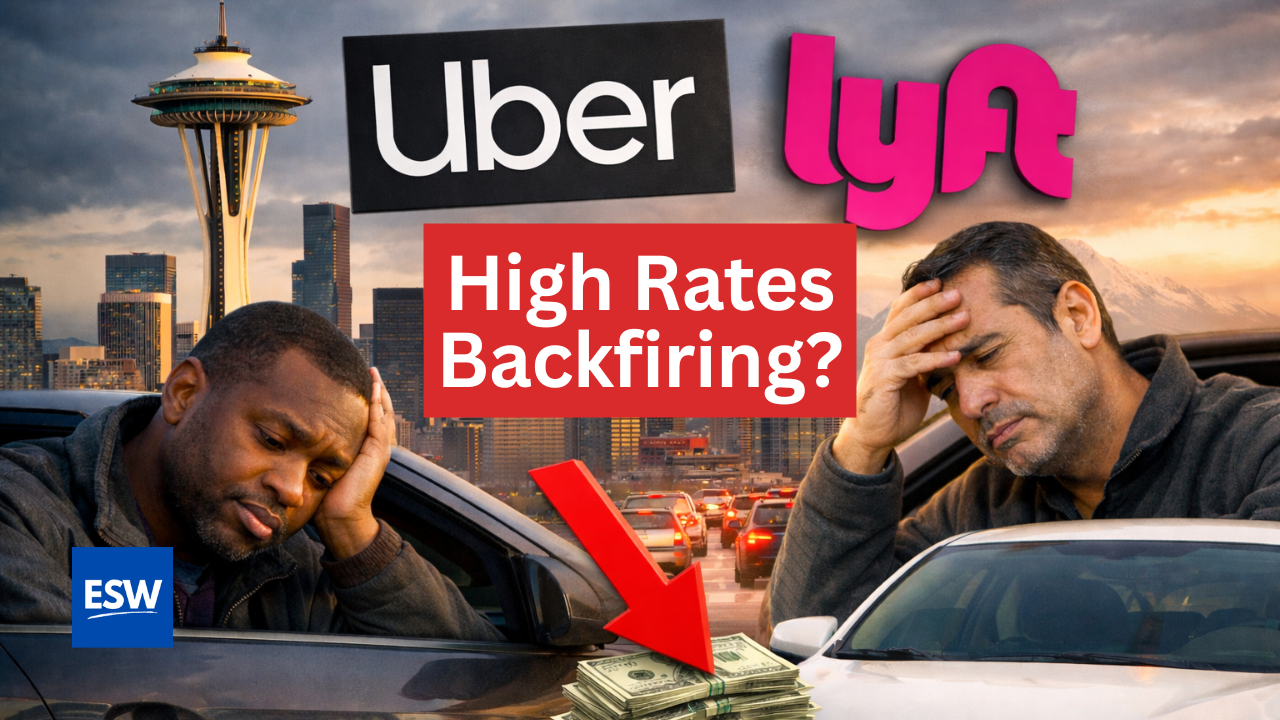
In a recent article by The Seattle Times titled “WA union for Uber, Lyft drivers says too many rideshares are on the road,” drivers in Seattle are asking Uber and Lyft to stop onboarding new drivers.
Why?
Because even in a city with some of the highest rideshare rates in the country, many drivers say they are struggling.
At first glance, that sounds contradictory. Higher rates should mean higher earnings, right?
Not necessarily.
Clip from The Jake & Spike Show LIVE – KIRO News Radio Feb. 26, 2026
Sources:
The Jake & Spike Show LIVE – KIRO News Radio
The Seattle Times news: WA union for Uber, Lyft drivers says too many rideshares are on the road
The Free Market Effect: When Opportunity Attracts Oversupply
Seattle introduced minimum pay standards that increased rider fares by roughly 40%, making it one of the most expensive rideshare markets in the country.
Higher pay naturally attracts more drivers.
And this is where the free market shows its power — and its consequences.
When paying conditions are significantly better than nearby cities or alternative jobs, people move toward that opportunity. Drivers relocate. Some commute long distances. Some temporarily live out of their cars just to tap into higher earnings.
I’ve personally heard stories like:
- Drivers commuting hours from nearby cities
- Drivers sleeping in their cars for weeks
- One driver years ago who would drive from Las Vegas to San Francisco, sleep in his vehicle, shower at a gym, and grind nonstop to maximize earnings
When money is tight, people do extreme things to make ends meet.
And in an open system with no cap on driver onboarding, saturation becomes almost inevitable.
No Cap, No Control
Unlike taxi medallion systems of the past, rideshare platforms generally do not cap the number of drivers.
Why?
Because drivers are independent contractors.
They:
- Choose when to work
- Choose how long to work
- Choose where to work
From the companies’ perspective, placing a cap introduces risk. What happens if too many drivers decide to take the day off? Passengers experience long wait times. Service reliability drops. Market share suffers.
From the drivers’ perspective, no cap means income dilution. Too many drivers chasing the same number of rides means:
- More “deadheading” miles
- Lower trip volume per driver
- Longer idle times
- Increased frustration
Both sides are caught in a structural tension.
“Pay Us Well and We’ll Take Care of Business”
Many veteran drivers remember the early days.
Back then:
- Fewer drivers
- Higher bonuses
- More consistent surge
- Stronger take-home pay
Drivers didn’t need to organize. The money was good.
But let’s be honest.
Uber and Lyft lost billions of dollars for years trying to scale globally. If you owned a business — even something as small as a food truck — how long would you continue operating if you were losing money month after month?
Not very long.
Eventually, every company must answer to sustainability.
That means balancing:
- Driver pay
- Rider prices
- Investor expectations
- Market competition
And that balance is never perfect.
The Automation Reality
There’s another layer to this.
In a recent interview on The Diary of a CEO with Steven Bartlett, Uber CEO Dara Khosrowshahi acknowledged that autonomous vehicles will eventually become a large part of the platform. Driver Levi Spires from the YouTube channel Tip You in The App has also highlighted this in his own video. Watch the videos below for more context.
Companies like Waymo are already operating in multiple cities.
Whether we like it or not, self-driving vehicles are advancing.
This doesn’t mean drivers disappear tomorrow. But long-term, the landscape will change.
And that leads to a hard but necessary question:
Are we building an exit plan?
Plan B Is Not Optional Anymore
Each driver’s situation is different.
Some:
- Have limited options
- Are supporting families
- Have health limitations
- Are rebuilding financially
For others, transitioning to something new may be easier.
But one thing seems clear:
Rideshare is becoming less predictable.
Even in Seattle — one of the highest-paying markets in the country — drivers are struggling due to oversupply.
If high rates can still lead to saturation and reduced earnings, then income security cannot depend solely on local regulations or pay standards.
Drivers may need to seriously consider:
- Developing alternative income streams
- Building skills outside of rideshare
- Investing consistently
- Reducing debt
- Preparing financially for volatility
Not out of fear — but out of realism.
The Bigger Lesson
Seattle’s situation reveals something important:
In a free market system without caps, improved pay conditions can unintentionally create oversupply.
Oversupply reduces per-driver opportunity.
Reduced opportunity creates frustration.
And the cycle continues.
At the same time, companies must maintain operational flexibility and financial sustainability.
Both sides are navigating an evolving system that may look very different in five to ten years.
At the end of the day, only time will tell how this plays out.
But one thing is certain:
Drivers who prepare early will have options.
Drivers who don’t may find themselves reacting instead of adapting.
And in a rapidly changing gig economy — adaptation may be the most valuable skill of all.
Levi Spires from Tip You in The App.
Full interview on The Diary of a CEO with Steven Bartlett — Uber CEO Dara Khosrowshahi
Have Questions?
If this content sparked a question in you — or if you have ideas or comments on any topic related to finance — I invite you to share them here. Your questions might help others too.
Before you go…
If this topic resonated with you, I invite you to visit the homepage, where you’ll find a clear breakdown of all the topics I share and explore. From biblical studies and spiritual reflections, to personal growth, life lessons, and even deeper conversations around culture, systems, and conspiracy theories—everything is organized so you can easily find what speaks to you.
My goal is simply to share perspectives that invite reflection, encourage critical thinking, and help you see the world—and your own life—from a clearer and more grounded place.
Thank you for taking the time to read this.
Take what serves you, question everything else, and stay curious.
— Eduardo
Recommended reading: How to Get Out of Debt Quickly and The Simple Path to Wealth.