REF: ESW010826EN
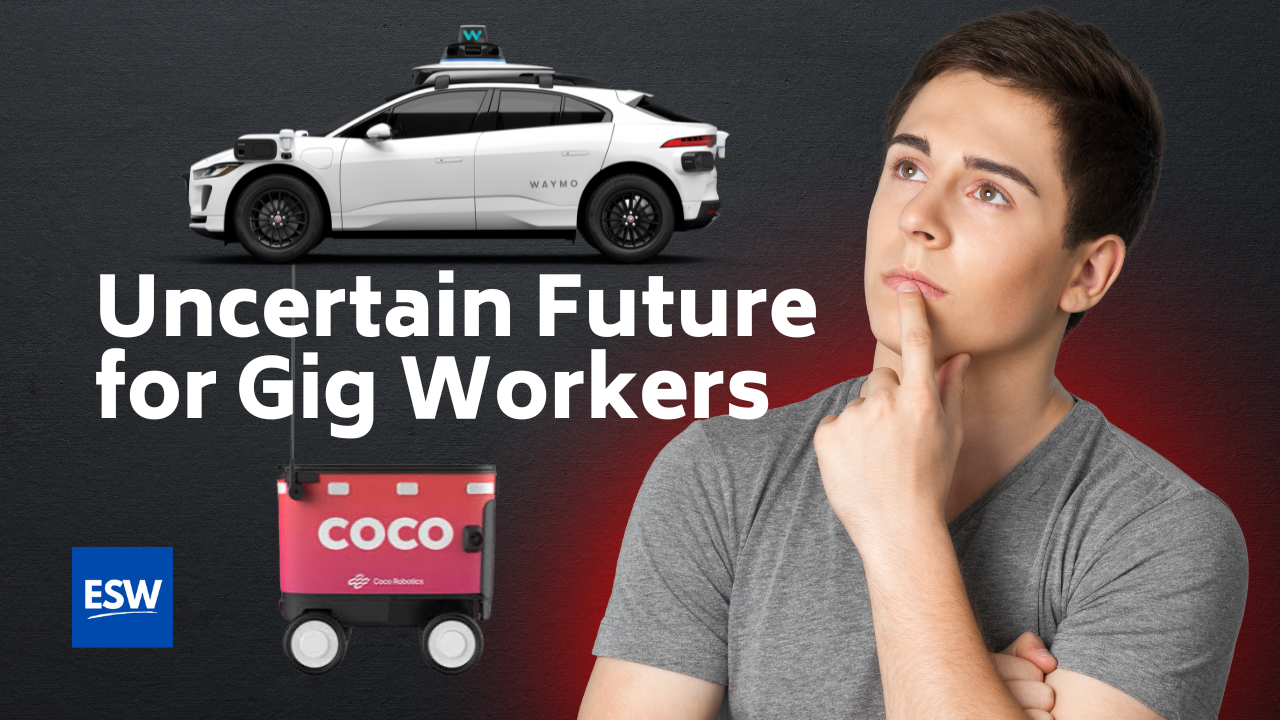
The gig economy—especially rideshare driving—has long been marketed as a symbol of freedom: work when you want, be your own boss, and make money with your car. But in a recent episode of Show Me The Money Club on The Rideshare Guy YouTube channel, host Sergio and co-host Chris cut through the slogans and focus on something far more important: where this industry is actually going.
You can find the video clip I created at the end of the article, or watch the full episode here.
Their discussion isn’t emotional. It’s strategic. And the picture they paint should make every driver—and anyone thinking of becoming one—pause.
The Gig Economy Is Not What It Used to Be
Sergio and Chris point out what many drivers are already experiencing firsthand. Earnings are not what they once were. Costs are rising. Markets are saturated. Inflation is quietly eroding whatever gains people think they are making.
Yet despite constant complaints, more and more drivers continue to enter the platforms. This creates a self-reinforcing problem: when there is always a new supply of drivers, companies have no incentive to improve pay, conditions, or long-term security.
The result is a system where drivers absorb nearly all the risk, while platforms retain nearly all the control.
The Companies’ True Direction: Automation Over Drivers
A central point in their conversation is that Uber, Lyft, and similar companies are not building a future around human drivers.
They are building a future around automation.
Massive investment is flowing into autonomous vehicle technology, artificial intelligence, and systems that reduce dependence on people. The logic is simple from a corporate standpoint: machines don’t get tired, don’t file lawsuits, don’t need incentives, and can run far longer than any human ever could.
Sergio and Chris explain that a single autonomous vehicle could eventually replace multiple human drivers simply by operating longer hours with fewer interruptions. Early signs of this shift are already visible in certain cities, where new technology is beginning to absorb rides that once went to drivers.
From this perspective, drivers are not being developed as long-term partners.
They are being phased out as a temporary solution.
Profit First, Always
They also make it clear that these companies are structured to serve investors, not workers. That reality explains much of what drivers feel today:
- shrinking payouts
- disappearing incentives
- worsening support
- shifting policies
- constant algorithm changes
These are not signs of companies struggling.
They are signs of companies optimizing.
Optimizing for scalability.
Optimizing for automation.
Optimizing for profit.
Human drivers, in this model, are a cost to be minimized.
Why Financial Positioning Is No Longer Optional
Sergio and Chris stress that gig work should not be approached as something to fix politically or wait on companies to repair. It must be seen realistically: as a shrinking opportunity window.
Their message is not panic. It’s preparation.
They urge workers to stop building their future on these platforms and start using them—if at all—as a temporary tool while creating something more sustainable outside the apps. That means developing skills, alternative income streams, and financial strategies that do not depend on rideshare demand.
Because once automation scales, there will be no negotiation phase.
There will only be displacement.
Inflation Makes the Situation Worse
Even if pay stayed flat—which it hasn’t—drivers would still be losing ground. Inflation alone ensures that the real value of each dollar earned keeps shrinking. That means many drivers are effectively working more to afford less.
When inflation is paired with market saturation and automation, the pressure compounds. Less opportunity. More competition. Lower real income.
This is not a temporary dip, It is a structural shift.
A Personal Perspective: Why I Believe Fewer People Should Be Entering Rideshare
I want to add something personal to this conversation, because this isn’t only about economics and technology. It’s also about people.
I fully understand and respect a free-market economy. Anyone should be free to choose how they earn money—whether that’s rideshare driving, learning a trade, working a job, building a business, or creating content online.
But freedom of choice does not mean every option is a good long-term investment of your time, money, energy, or assets.
One of the goals of this article is to discourage new drivers from joining Uber and Lyft with the intention of making a living from it. Not because people shouldn’t be allowed to try—but because under current and future conditions, this is becoming an increasingly poor long-term strategy.
Yes, for part-timers, rideshare can still function as a way to make extra cash. But even there, I would honestly encourage people to look seriously for other ways to earn that money. The market is already saturated. Every new driver divides a fixed demand into smaller and smaller pieces.
A saturated market doesn’t hurt the companies.
It hurts the drivers.
More drivers means fewer requests per person, more unpaid downtime, lower effective hourly income, and growing desperation that pushes people to accept worse and worse offers.
And this is where the conversation often misses something important.
There are people for whom driving is not just a side hustle. It is the best—and sometimes the only—realistic option they have.
People who face physical limitations.
People caring for family members.
People who cannot work fixed schedules.
People who face age, language, or background barriers.
For many of them, flexibility is not a lifestyle perk. It is a necessity.
When capable individuals with many options flood these platforms, they unintentionally make survival harder for those who don’t have those same options. For someone whose entire income depends on rideshare, a saturated market is the worst possible scenario.
If you are physically able, if you can build skills, learn a trade, work a job, start a business, or develop online income, my honest view is this:
Consider doing that instead.
Leave this space, as much as possible, for those who truly need the flexibility it offers. In a healthier, less crowded environment, those drivers would at least have a chance to maintain a more stable income—if that is even going to remain possible as automation expands and companies continue pushing pay downward.
Because the reality is, even that window may be closing.
Self-driving technology is advancing. Corporate investment is not aimed at improving drivers’ lives. It is aimed at replacing them.
This isn’t about gatekeeping.
It’s about awareness.
It’s about responsibility.
And it’s about encouraging people who still have room to maneuver to build something more sustainable—before this door narrows even further.
Final Thoughts
The message Sergio and Chris are conveying is ultimately a warning.
These platforms are not evolving toward a driver-centered future. They are evolving toward an automated, investor-centered one.
The instability drivers feel today is not a glitch. It is a preview.
The most important work gig workers can do right now is not chasing bonuses, acceptance rates, or temporary incentives—but building financial and professional foundations that exist outside these systems.
Because the future of rideshare is not human.
And the sooner people prepare for that, the better positioned they will be.
A Note on Organizing and Community Action
I do believe that formally organizing—with the support of legislation—to seek better pay, improved working conditions, and real deactivation protection is very important. At the same time, I believe drivers can also apply practical strategies at the local level, such as being highly selective and only accepting truly profitable ride offers. When a community of drivers consistently refuses low-paying trips, it sends a signal to the system that those rides are not worth taking, which can potentially pressure the algorithm to increase pay to avoid leaving passengers stranded.
Still, even with organizing, strategy, and community effort, the reality is that we are ultimately trying to stay afloat while powerful forces—new technologies, corporate investment priorities, and legislation—move in their own directions. Because of that, alongside collective action, each driver should seriously be thinking about a long-term exit plan in an AI-driven world, if they choose to do so. I truly wish every gig worker the best. Stay positive, and stay safe out there.
Watch the full episode
Check out Sergio’s Stock Market Educational website: sergioavedian.com and his YouTube Channel.
Check out Chris’ YouTube Channel
Have Questions?
If this content sparked a question in you — or if you have insights or comments on any technology — I invite you to share them here. For finance topics, click here. Your questions might help others too.
Before you go…
If this topic resonated with you, I invite you to visit the homepage, where you’ll find a clear breakdown of all the topics I share and explore. From biblical studies and spiritual reflections, to personal growth, life lessons, and even deeper conversations around culture, systems, and conspiracy theories—everything is organized so you can easily find what speaks to you.
My goal is simply to share perspectives that invite reflection, encourage critical thinking, and help you see the world—and your own life—from a clearer and more grounded place.
Thank you for taking the time to read this.
Take what serves you, question everything else, and stay curious.
— Eduardo