REF: ESW021226EN
Did you just sign up and you’re ready to make money?
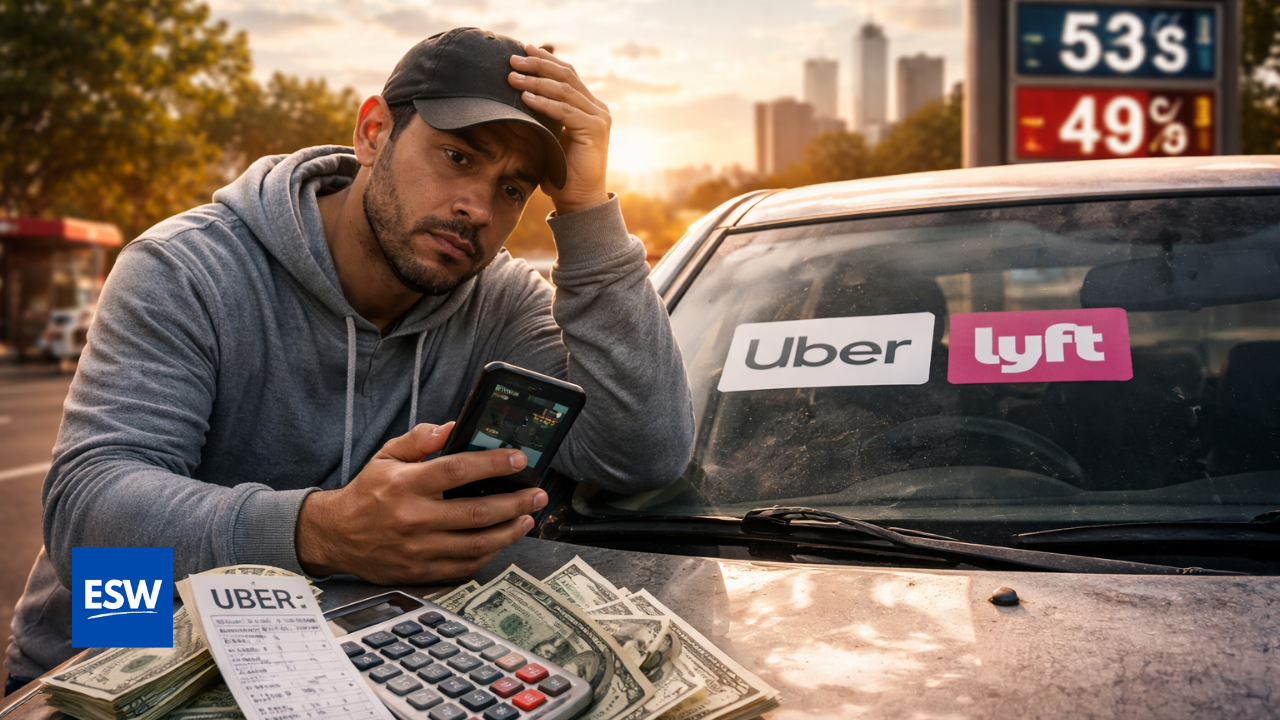
You got approved for Uber or Lyft, or maybe both. You’re excited. Finally, a way to make extra cash. Maybe you want to supplement your income. Maybe this is going to be your full-time thing. Maybe you just need money for something specific.
So you turn the app on and off you go.
Yeah, let’s make money.
If you truly want to make this profitable, keep reading. And I promise you something: I will not sugarcoat it. This is just the brutal reality.
But first, before you drive another mile, let’s hit the brakes hard. Pull over. Shut the car down. Turn it off. Take a deep breath.
Because what you’re about to read might completely change the way you think about this job.
The Excitement vs. The Reality
Gross Earnings Are Not Profit
One of the biggest mistakes new drivers make is confusing gross income with profit.
You drive a few hours and see $200. It feels good. You see $1,200 for the week. Even better.
But that’s not profit. That’s revenue.
Under current Uber and Lyft conditions — upfront pricing, long pickups, inconsistent bonuses, lower per-mile rates in many markets — if you are not strategic about where you drive, when you drive, and which rides you accept, there’s a very real chance you are barely breaking even.
Or worse, you are slowly destroying your car for short-term cash flow.
If you accept everything that comes your way, you’re not running a business. You’re reacting to an algorithm.
And that rarely ends well.
Inflation: The Money Is Not the Same
There’s another factor most drivers are not thinking about.
Making $300 a day before COVID is not the same as making $300 a day in 2026.
Because of inflation, the same $300 buys you less today than it did a few years ago.
Psychologically, you might think, “I’m making the same money I used to.”
But the shocking reality is that you’re not.
Fuel costs more. Tires cost more. Oil changes cost more. Insurance costs more. Food costs more. Everything costs more.
And here’s another uncomfortable truth: to make that same $300 today, many drivers have to be out there 12 to 16 hours a day. That includes breaks, lunch, bathroom stops, slow periods, traffic, and dead time between rides.
So not only is the money worth less, but you’re often working longer hours to earn that same devalued amount.
In real terms, that’s a double hit.
The Social Media Illusion
You’ve probably seen it.
A driver posts in a WhatsApp group or on social media: “Just made $2,500 this week!” Screenshots. Celebration.
What they’re not telling you is the full story.
Maybe they’re driving a Cadillac Escalade or a limo SUV.
Maybe they have a fleet of cars.
Maybe they have a chauffeur license and commercial insurance.
Maybe they’re doing private clients.
Maybe they serve high-end or celebrity-level passengers who tip $100 or more.
Or maybe they simply want to brag.
Or sell you a course.
Or push an affiliate product.
Or grow their YouTube channel with outrageous claims.
Or get you to sign up using their Uber or Lyft referral code so they can make money from it.
Don’t let that fool you.
For the average driver doing UberX with a Toyota Corolla, making that kind of money consistently is a very long shot. Context matters. Vehicle class matters. Market matters. Strategy matters.
Comparing your reality to someone else’s highlight reel is a dangerous game.
The $50 an Hour Illusion
Let me give you a simple illustration.
Imagine you have a job that pays you $50 an hour. Sounds amazing.
But to earn that $50, you have to spend $30. In reality, you’re only making $20 an hour. Now compare that to a strategic veteran driver who is highly selective and only accepts profitable rides (cherry-picking).
What if you have to spend $40 to earn that $50? Now you’re only making $10 an hour. Compare that to a driver who focuses on keeping their acceptance rate high by accepting almost every ride offer (the “ant driver”).
That’s exactly what happens in rideshare when you don’t account for expenses.
You have to spend money to make money in this business. Gas, maintenance, depreciation, insurance, taxes — all of it eats into what looks like “good pay.”
You cannot spend 100% of what you earn and assume nothing will happen.
Something is happening. You just might not see it yet.
The True Cost of Operating Your Vehicle
Whether you own your car or rent it, this is a business. And businesses have expenses.
If You Own the Vehicle
Fixed expenses:
• Car payment
• Auto insurance (including rideshare coverage -TNC endorsement- if required)
• Registration and tag renewal
• Property taxes on the vehicle (in some states)
• Phone payment
• Phone plan with unlimited data
• Accounting or mileage tracking apps
• Dash cam (spread out over time)
Variable expenses:
• Gasoline or electricity
• Public charging fees
• Oil changes
• Brake pads and rotors
• Tires and rotations
• Wheel alignments
• Transmission service
• Engine maintenance
• Air filters
• Spark plugs
• Coolant
• Wiper blades
• Car washes
• Cleaning supplies
• Occasional detailing
• Unexpected repairs
• Insurance deductibles
• Lost income during breakdowns
• Depreciation
If You Rent the Vehicle
• Weekly rental fee
• Rental insurance
• Deposits
• Mileage overage fees (if any)
• Fuel or charging
• Cleaning
• Lost income during downtime
Depreciation: The Silent Killer
If you’re driving 40,000 to 60,000 miles a year, you are not using your car normally. You are compressing years of wear into a short period of time.
Your car is losing value much faster than you think.
That loss doesn’t hurt today. It hurts later — when it’s time to replace the vehicle.
Do you have a replacement fund?
Or are you hoping nothing major breaks?
Taxes: What Deductions Really Mean
You are not an employee. You are self-employed.
That means:
• Federal income tax
• State income tax (if applicable)
• Self-employment tax (a percentage on net profit for Social Security and Medicare)
• Possibly quarterly estimated payments
A deductible expense is not a dollar-for-dollar tax credit.
Business expenses reduce your taxable income, not your tax bill directly. The actual savings depend on your tax bracket, filing status, total household income, whether you use the standard mileage deduction or actual expenses, and state tax rules.
Two drivers with the same gross earnings can owe very different amounts in taxes.
This is why you should check with a qualified accountant. The percentage impact of deductions varies depending on your specific situation.
If you don’t set aside money throughout the year, tax season can hit hard.
And if you can’t pay, penalties and interest start adding up.
Cash Flow vs. Real Profit
Money coming in every week feels good. But cash flow is not profit.
If you drive full-time without being selective, you are:
• Increasing maintenance
• Burning through tires faster
• Accelerating depreciation
• Increasing tax exposure
• Reducing your car’s lifespan
If you don’t have:
• An emergency fund
• A maintenance reserve
• A tax reserve
• A vehicle replacement plan
You are exposed.
Personally, I use the Oportun app to automate savings and create specific goals: emergency fund, maintenance, tires, taxes, even vacation. If you don’t separate that money intentionally, it will disappear.
The Business Mindset
If you opened a restaurant or a retail store, you would calculate rent, utilities, insurance, equipment, payroll, and taxes before calling it profitable.
Rideshare is no different.
Your car is your storefront.
Your fuel is your inventory.
Your maintenance is your overhead.
Your taxes are your obligation.
Ignore those factors, and the outcome is predictable: you go out of business!
Don’t Get Addicted — Have an Exit Plan
Here’s another heads-up.
Don’t get addicted to ridesharing.
It’s easy to get hooked on daily cash flow. The app dings, the money comes in, and you feel productive.
But always have your exit plan ready to execute.
Be mindful about your Plan B.
Let’s face it: AI, automation, and robots are here to stay.
AI and autonomous vehicles are here to stay. We can’t simply be in denial, hoping that the government will somehow protect human drivers over self-driving cars.
Just take a look at what’s already happening. It’s only a glimpse of what’s coming.
Whether we like it or not, the landscape is changing.
Honestly, I truly believe it’s time to start thinking differently. Maybe that includes considering investing in assets that could participate in the future instead of competing against it — like a Tesla Robocab equipped with Full Self-Driving software and hardware that might be used on Tesla’s robotaxi network.
You don’t have to agree with me. But at least think about it.
Run the Numbers — Seriously
If you are part-time, run the numbers.
If you are full-time, run them twice.
Calculate:
• Total monthly gross income
• Total fixed expenses
• Estimated variable cost per mile
• Depreciation
• Estimated taxes
Subtract everything.
What’s left is your real profit.
Closing Thoughts: The Brutal Truth
If after reading this you are not uncomfortable — maybe even a little sick to your stomach — read it again.
If you ignore this information and don’t manage this gig like a real business, you might regret it later.
When the big repair hits. When the tax bill shows up. When the car is worn out and you have nothing saved.
And in that moment, you might hear my voice in your head saying, I told you.
Think about it. Think hard.
Ask yourself if you’re willing to treat this seriously and do it right.
I’m not trying to be harsh. This is just plain, simple, brutal truth.
When you tell someone the truth, they might appreciate you — or they might hate you for it.
I hope you appreciate me for saying it up front without sugarcoating it.
Take care. God bless.
And before you go, you might want to read another article I wrote about How to Buy Your Freedom. This is something I’ve been doing for several years, and it might be worth looking into if you’re thinking long term about your finances and your future.
Before you go…
You might also want to check out our free Financial Calculators page, where you can explore different scenarios and see how small changes could help you improve your financial situation and build a stronger financial future.
If this topic resonated with you, I invite you to explore the homepage, where you’ll find a wide range of topics I share and reflect on. From biblical studies and spiritual questions, to personal growth, life lessons, technology, culture, systems, and even controversial or unconventional ideas—everything is organized so you can explore what genuinely interests you.
My goal is not to tell people what to think, but to encourage reflection, honest questioning, critical thinking, and a deeper awareness of the world around us—and the life we are personally building within it.
Thank you for taking the time to read this.
Take what is useful. Test everything. Stay curious. Keep thinking for yourself.
I’m just a regular guy sharing what I’ve learned, questioned, experienced, and observed along the way. If you ever want to connect, ask something, challenge an idea, or simply share your own perspective, feel free to reach out at edsilvaworld@pm.me.
Sometimes a simple conversation can change the direction of someone’s life.
Eduardo