REF: ESW012726EN
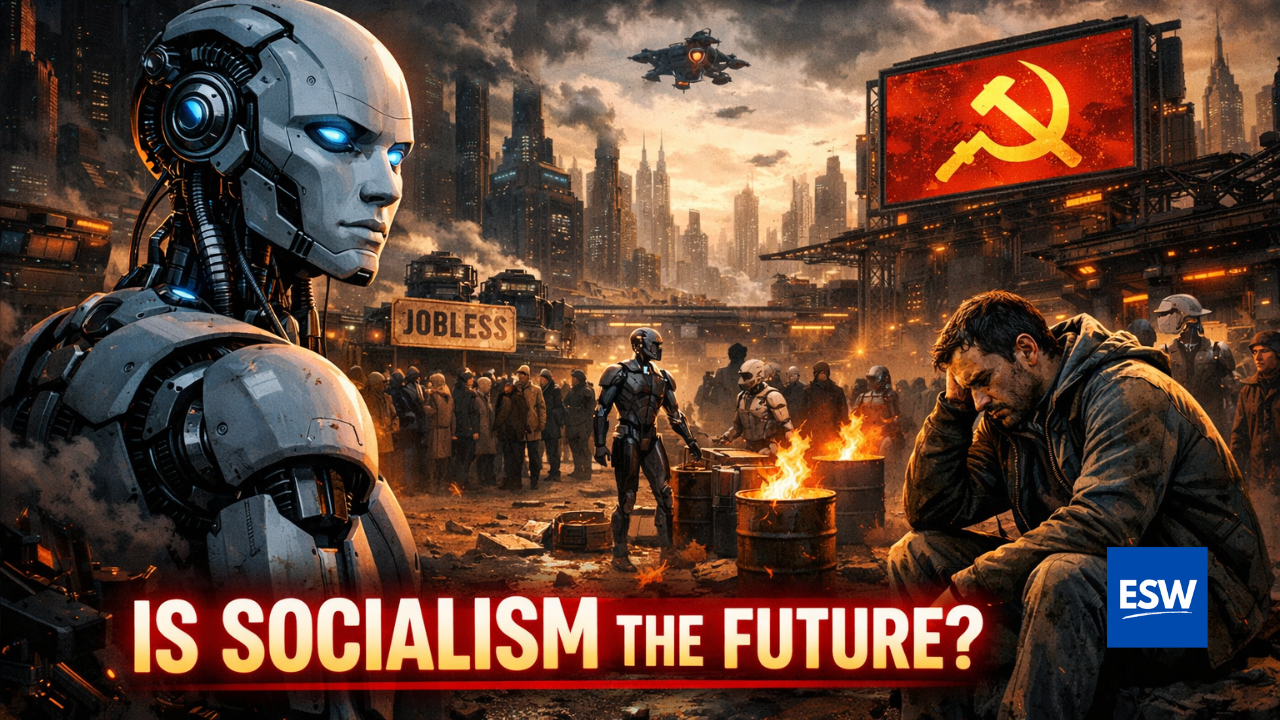
This article is based on a shocking video clip from an interview hosted by Steven Bartlett with political commentator Konstantin Kisin. The clip focuses specifically on their discussion around artificial intelligence, robotics, and whether socialism could emerge as a possible outcome of mass job displacement.
On a personal note, I truly hope none of this becomes a reality. However, the geopolitical forces at play and the immense greed of tech giants seem to be steering us toward what could be an unprecedented collapse of human society. I genuinely believe that if God doesn’t intervene, the consequences could be devastating.
— Eduardo Silva
At the end of this article, you can find the full interview, where Steven Bartlett and Konstantin Kisin also explore other major issues, including the geopolitical forces reshaping the world as we know it.
One of the most revealing moments in the conversation has nothing to do with wars, alliances, or global power struggles. It is the moment when the discussion shifts toward artificial intelligence—and suddenly, many of today’s social and political tensions begin to make sense.
According to Konstantin Kisin, the renewed interest in socialism is not happening in a vacuum. It is not simply ideological drift, generational rebellion, or the result of social media radicalization. It is being driven by something deeper and far more unsettling: the growing realization that work itself may be disappearing.
Not gradually.
Not over generations.
But rapidly.
AI Is Not “Coming.” It’s Already Here.
Steven Bartlett grounds the discussion with a simple but powerful example: getting into a car that drives itself. Not partially. Fully. For hours. No steering wheel input. No pedals. No human intervention.
That detail matters because driving is one of the largest professions in the world.
Taxi drivers.
Uber and Lyft drivers.
Delivery drivers.
Truck drivers.
When autonomous vehicles scale—and both Bartlett and Kisin agree they will—those jobs do not slowly evolve. They disappear.
And that is only one industry.
The conversation expands into robotics, autonomous humanoid machines, and the explosion of innovation happening right now. Kisin highlights a crucial insight: the physical components of robots have existed for decades. Motors, sensors, arms, actuators—none of that is new.
What was expensive was intelligence.
The brain.
That cost has collapsed.
When intelligence becomes cheap, everything changes. Machines can now see, reason, adapt, learn, and act at levels that once required human cognition. This is why startups are flooding into robotics and why entire accelerators are now filled with founders building machines instead of apps.
This disruption is fundamentally different from anything that came before it.
This Time, There Aren’t Enough New Jobs
Historically, technological disruption has always destroyed jobs—but it also created new ones. Farming gave way to factories. Factories gave way to offices. Offices gave way to digital work.
The assumption has always been that something replaces what is lost.
Kisin challenges that assumption directly.
If AI systems and robots can perform physical labor, cognitive labor, creative tasks, and even decision-making faster, cheaper, and more reliably than humans, what exactly remains at scale?
Not everyone can become an AI engineer.
Not everyone can work in robotics.
And even those roles are increasingly automated themselves.
The result is a growing population—especially among younger generations—who are educated, ambitious, and increasingly unnecessary to the economic system.
That is not just an economic problem.
It is a psychological one.
Why Socialism Starts to Look “Reasonable”
This is where the discussion becomes uncomfortable—and unusually honest.
Despite being a long-time critic of socialism and communism, Konstantin Kisin makes a statement that initially sounds shocking:
In a world where no one has jobs, communism starts to make sense.
Not because it is morally superior.
Not because it has worked historically.
But because the alternative is social collapse.
If robots generate most economic value, and that value accrues to a small group of people who own the systems, what happens to everyone else?
You cannot invent fake jobs forever.
You cannot tell millions of people to “reskill” into roles that do not exist.
And you cannot expect social stability when people cannot afford housing, families, or a future.
In that scenario, redistribution stops being an ideology. It becomes a pressure valve.
Kisin states it bluntly: redistribution will happen either voluntarily—or through force.
That is the reality many societies are unprepared to face.
AI Anxiety Is Fueling Extremism
Another critical point raised in the conversation is that fear alone reshapes behavior long before mass unemployment fully arrives.
People are already being told by executives to “learn AI or be replaced.” Public messaging increasingly signals that humans are becoming optional. Entire professions are being warned—implicitly or explicitly—that their time is running out.
That messaging corrodes trust.
When people feel replaceable, expendable, and powerless, they reach for systems that promise security and fairness—even if those systems are historically flawed.
This helps explain why socialism is resurging in major cities.
Why younger generations openly discuss redistribution.
Why extreme rhetoric gains traction.
This is not primarily driven by envy.
It is driven by fear.
Fear that effort no longer guarantees survival.
The Wealth Will Concentrate—Fast
Steven Bartlett and Konstantin Kisin also touch on a rarely acknowledged reality: AI accelerates wealth concentration.
AI does not merely make companies more efficient. It allows small teams—or even individuals—to scale output to levels that once required massive organizations.
That means fewer employers.
Fewer job creators.
And more wealth flowing to fewer hands.
When that concentration coincides with mass job displacement, the political consequences are predictable.
People demand guarantees.
They demand income without work.
They demand protection from a system that no longer needs them.
Whether it is called socialism, universal basic income, or something entirely new, the label matters less than the pressure behind it.
We Are Not Prepared for This Transition
Perhaps the most sobering insight from the interview is not that AI will change everything.
It is that no one truly knows how to manage the transition.
Education systems are outdated.
Welfare systems were never designed for permanent joblessness.
Cultural narratives around work, purpose, and identity are built on assumptions that are now collapsing.
Even if AI delivers extraordinary benefits—medical breakthroughs, abundant energy, cheaper goods—the path to that future will be turbulent.
Especially for young people.
Especially for those already on the margins.
Especially for societies already strained by debt, inequality, and distrust.
The Core Issue Isn’t Technology. It’s Meaning.
Beneath all the discussion about AI, socialism, and economics lies a deeper question:
What happens to human meaning when work disappears?
Work is not only how people earn money.
It is how they structure their lives.
How they gain dignity.
How they feel useful.
Remove that foundation without replacing it with something equally grounding, and instability becomes inevitable.
That is why this conversation between Steven Bartlett and Konstantin Kisin matters.
Not because it predicts the future perfectly—but because it forces an uncomfortable realization:
AI does not merely threaten jobs.
It threatens the social contract itself.
And if that contract breaks, people will demand a new one—no matter what name it goes by.
You can watch the full interview below to hear Steven Bartlett and Konstantin Kisin discuss this topic in greater depth, along with the geopolitical and cultural forces shaping our rapidly changing world.
Host Steven Bartlett interviews political commentator Konstantin Kisin, who breaks down Iran’s turning point, how Greenland could reshape global power, why mass immigration must stop, and how Trump’s actions in Venezuela expose Europe’s growing weakness.
Konstantin Kisin is a political thinker and co-host of the podcast TRIGGERnometry, widely known for his sharp analysis of geopolitics, immigration, and culture. He is also the best-selling author of An Immigrant’s Love Letter to the West.
Before you go…
If this topic resonated with you, I invite you to explore the homepage, where you’ll find a wide range of topics I share and reflect on. From biblical studies and spiritual questions, to personal growth, life lessons, technology, culture, systems, and even controversial or unconventional ideas—everything is organized so you can explore what genuinely interests you.
My goal is not to tell people what to think, but to encourage reflection, honest questioning, critical thinking, and a deeper awareness of the world around us—and the life we are personally building within it.
Thank you for taking the time to read this.
Take what is useful. Test everything. Stay curious. Keep thinking for yourself.
I’m just a regular guy sharing what I’ve learned, questioned, experienced, and observed along the way. If you ever want to connect, ask something, challenge an idea, or simply share your own perspective, feel free to reach out at edsilvaworld@pm.me.
Sometimes a simple conversation can change the direction of someone’s life.
Eduardo